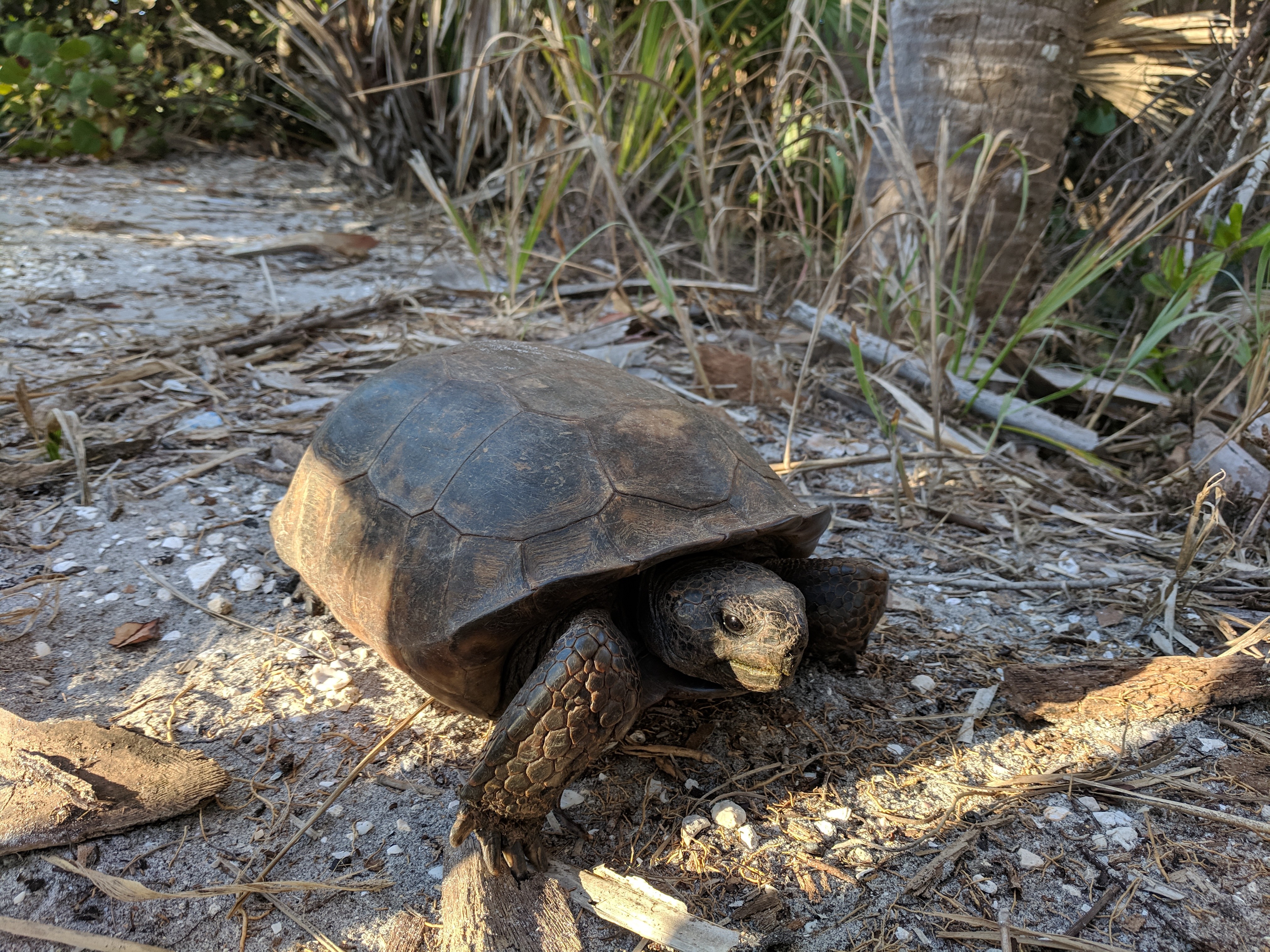
Gopher tortoises on Amelia Island now face what scientists call an extremely high risk of extinction in the wild after a global conservation reclassification.
The International Union for Conservation of Nature (IUCN) upgraded the species from "vulnerable" to "critically endangered" on July 10, its first status update in 30 years. The assessment estimates populations have declined roughly 80% over the past 120 years, according to a Center for Biological Diversity press release issued the same day.
The reclassification does not reflect a sudden collapse. The IUCN described the change as reflecting newly available data and reassessment, ClickOrlando reported.
Habitat destruction has reduced the tortoise's longleaf pine habitat to less than 3% of its original extent, the assessment found. Research cited in the assessment predicts 69% to 91% additional declines over the next two tortoise generations. No monitored population anywhere in the species' range has a positive growth rate, according to Hunter Howell, a co-author of the assessment.
What it means in Florida
The new global classification does not directly change Florida law, according to the Florida Fish and Wildlife Conservation Commission (FWC). The gopher tortoise remains a state-designated threatened species, the highest level of state protection FWC can provide, the agency told ClickOrlando.
FWC approved a 10-year Gopher Tortoise Management Plan in December 2024 containing 63 conservation actions. Under existing Florida law, moving, harming or disturbing a gopher tortoise, its eggs or its burrow without a permit is illegal. An FWC permit is required before any construction or work within 25 feet of a potentially occupied burrow.
Gopher tortoises in parts of Louisiana, Mississippi and western Alabama receive federal Endangered Species Act (ESA) protections. Populations in eastern Alabama, Florida, Georgia and South Carolina have waited for federal ESA protection since 1982. In 2023, the Center for Biological Diversity and Nokuse Education, Inc. sued the U.S. Fish and Wildlife Service for denying that protection.
A keystone species on Amelia Island
The gopher tortoise is the only tortoise species east of the Mississippi River. More than 350 species share its burrows, according to FWC.
On Amelia Island, residents regularly watch the animals cruise out of the dunes and head straight for the Atlantic Ocean. Waves roll them around in the surf. They return to shore and repeat the cycle for minutes or up to an hour. Experts believe the behavior may involve parasite removal, cooling off or relocating downshore, according to a Fernandina Observer column by Angela Ray published Monday, Sept. 21.
People should never place a gopher tortoise in the water. Land tortoises cannot swim. FWC does allow a person to move a tortoise across a road in the direction it was already traveling, but the animal should not be placed in a vehicle or taken elsewhere.
Eileen Tramontana, executive director of the Trout Lake Nature Center in Eustis, warned that fragmented habitats are pushing populations toward a tipping point. "I think we are very, very close to losing sustainable populations," Tramontana told ClickOrlando. "If the males and females can't find each other, if you don't have genetic diversity, you're going to have issues with future generations."
Long-lived adult tortoises can mask serious population problems such as declining reproduction, the IUCN assessment noted. Ray's Fernandina Observer column is the first of a three-part series, with the next installment covering the tortoise's role in its broader ecological community.
Upcoming community events
- Monday, Sept. 28: Nassau County begins Wilson Neck boat ramp upgrades.
- Thursday, Oct. 1: Fernandina Beach Library drops Saturday hours.
- Monday, Oct. 5: Nassau County voter registration deadline.
.jpg)